
Hi Everyone!
I’m back! I might have not posted for a little while, but there’s no sense in…
…oh. THAT LONG? Umm…
Look. I’ll get into the VERY IMPORTANT reasons I’ve been away, but first, I have to warn you all about our great common enemy, the Sun.
And no, I’m not just bitter that I flew almost 4000 km to see the eclipse on an overnight flight, and it was cloudy almost all day.
I’ve already seen one of them…

… so I’m perfectly happy, and why would I care about the $800 flight that I wasted my money on. That’s only Canadian money after all, so in America, it’s only about five chocolate bars. Okay, maybe KING size ones! I’m writing because this is urgent and nobody is aware of it! I have to get my message out, and the sun has done a good job infiltrating its ‘solarist’ propaganda into the media.
I have it on good authority that the sun causes cancer. It damages eyes, damages electronics, and have you seen what it does to ants? Next time you have magnifying glass with you on a sunny day, take a close look at the poor ant. It’s horrific.
If you speak to one of those Sun apologists, they will tell you that we need the sun to warm the earth. But what does the sun warming the earth get you? Climate change! We have our own man-made heaters. We can warm the earth with electric heaters, and that way we can control just how warm it will get.
So, I’ve spent the last… How long was it again? Really? You’re sure you didn’t miss a decimal point?…observing and analyzing the sun for weaknesses, and it’s now time to release my secret notes to the public. Note one. Since starting the observations, I have black spots in my vision that aren’t going away. I don’t know what they are, because doctors are in the pocket of ‘big sun’. I suspect that the sun is deplying countermeasures. We all know it really doesn’t like being observed.
Lets look at the sun.

No, not that photo. I already said that. I’ve already shared that photo enough times and even I’m gettign bored of it. No more. I promise. I need to let go of the past and move forward, to the more recent past.
Last summer, we had a bad wildfire year(as opposed to 2022, where we had a bad wildfire year, or the bad wildfire year in 2021, not to be confused with the bad wildfire year in 2020… there might be a pattern if you’re a meteorologist, but I’m not seeing it). With the haze in the sky that day, I could look at the sun with the naked eye(well, except for my prescription eyeglasses, which I need to see anything). In fact, for the first time I can recall, I could see at a sunspot with the naked eye. There was a black speck in the bottom centre of the sun. I thought it might be a weather balloon, or aircraft, or UFO, but it moved with the sun. Of course I had to get a photo of it:
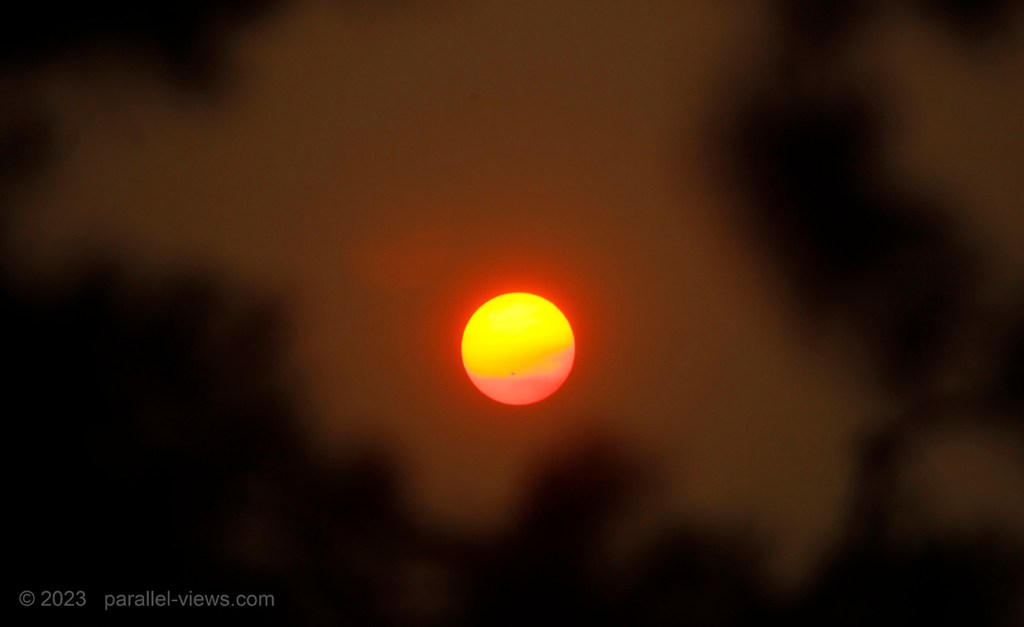
A sunspot is a cooler part of the sun. A strong temporary magnetic field blocks & redirects some energy from reaching the surface, so it isn’t as warm as the rest of the sun. As the brightness is related to heat, it looks darker. Well, I got a photo. And if I got a photo, couldn’t I get a better photo? With a telephoto lens, it turned out that the sunspot was actually two sunspots:

Here’s the image split into the usual three channels: red, green, blue:

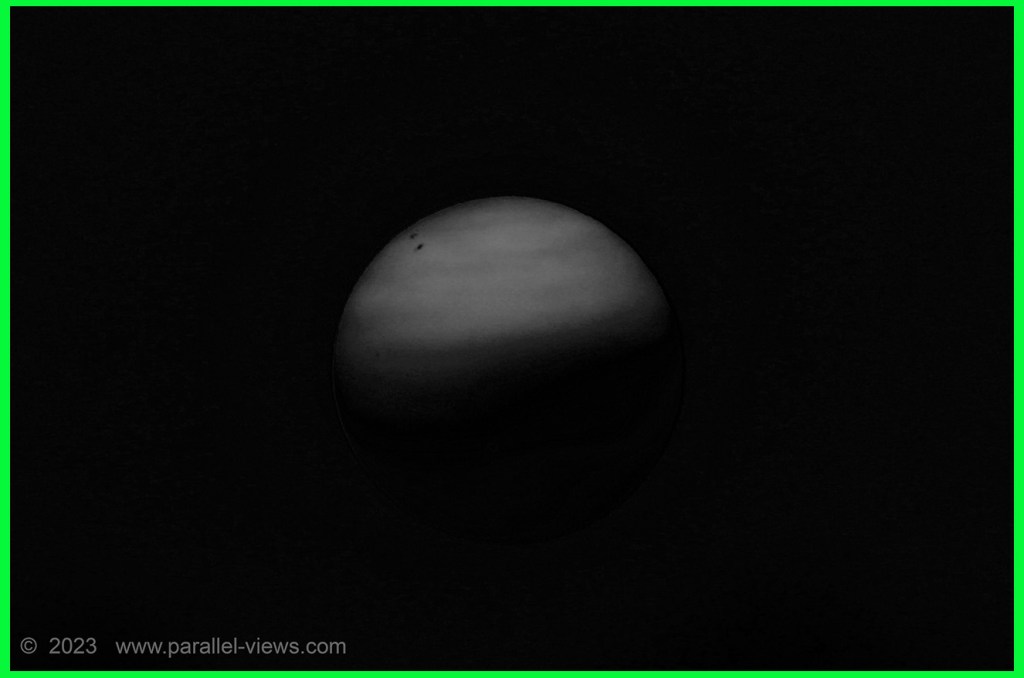

So, there’s some significant differences here. Red shows the best view of the twin sunspots, and honestly, the best view of the sun. That makes sense- it’s a very red photo. The thicker haze from the smoke obscures the sun in the green channel; the bottom is gone. However, green shows two smaller sunspots near the top of the sun; red is so bright that they’re washed out.
Blue is just useless. Or is it? I mean, the channel as directly taken from the camera is useless, but what if we boost the contrast? COMPUTER, ENHANCE.

Okay, that is cool. It looks like it should be in a science fiction movie, taken with technology that I would in no way be able to afford. The upper sunspots are clearly visible here. The thicker haze near the horizon does block the sunlight in the blue channel. What if I do it in green? COMPUTER, ENHANCE!

Not as fun as blue, but it’s still clearer. The red channel already has a strong contrast, so I don’t think I can enhance it much more. That never stopped me before, though! COMPUTER, ENHANCE!
…look, we both know I’m doing it manually. I’m just trying to look cool and pretend I’m in the future. Just give me this.

It’s very slightly brighter, but not enough to be noticeable unless you want to compare the photo side by side.

So yeah. the boosted channels are worth it. In fact, it seems a shame to NOT put them back together into a colour photo.

It looks artificial, and it is, but the sunspots are much cleaner. Not bad for a photo taken with no filters. I mean it, too. I didn’t even need a solar filter to block the sunlight- this is taken with a regular camera.
… And that ain’t what I do, so lets add filters.
I first tried my Kolari UV- the most responsive filter I have for ultraviolet light. The spectrum allowed through the camera is primarily UV, but brushes up again the visible spectrum(source- I can see through it if I’m looking at something bright). I know from past experience that smoke and haze block UV light, but surely if I point it at the sun, I’ll get something?

Barely. I had to boost the ISO way up(why it looks grainy), drop the exposure, and even then it was a 1/25 second long exposure. The longer exposures with reduced noise didn’t turn out, as it was windy and the camera was shuddering even on the tripod. The large sunspots are barely visible, but are there; they might have been clearer if it wasn’t so grainy. I might have even been able to see the small ones.
Infrared, on the other hand, does a good job cutting through haze.

This time, I did have to use a neutral density filter; it was too bright with my Zomei 950 nm filter. And what do I get? the sun is clear and bright, the sunspots are visible, both below and above. I think that the haze is barely a factor here. Whereas it made the top of the red channel too bright to see the sunspots, and obscured the bottom of the sun for the green and blue ones, in infrared the sun’s brightness is even. It’s a shame the sunspots don’t stand out more. This range doesn’t seem as responsive as the visible spectrum. I hate admitting that, but red does seem to be the best overall. Lets go back to red. But maybe… a different red?
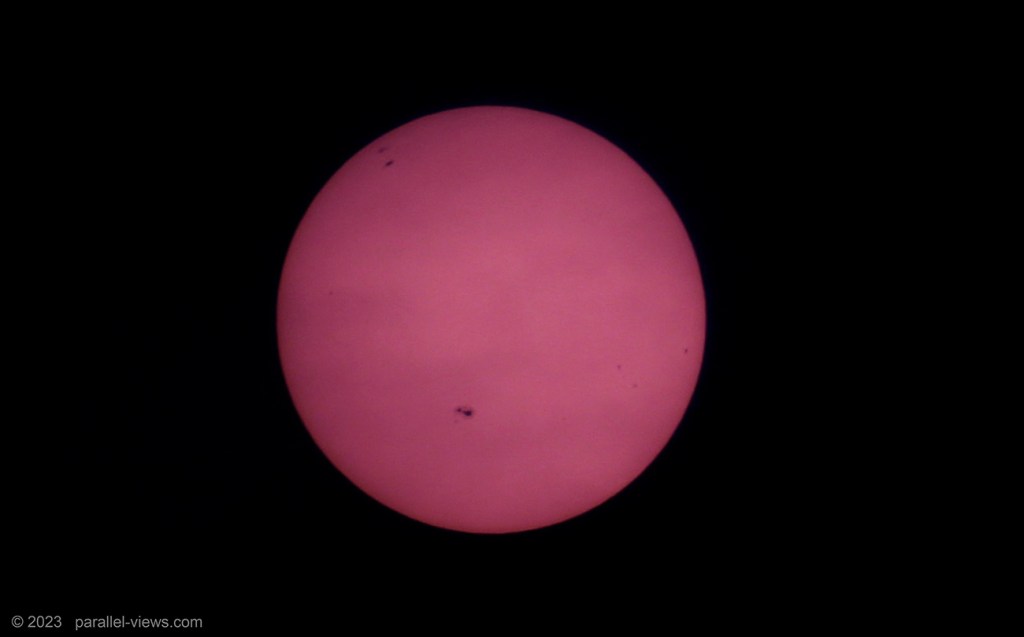
This photo was taken with my rarely-used Baader H-Alpha filter. This isn’t infrared, or ultraviolet, or even the secret ultrared or infraviolet(if you know, you know). It’s a visible spectrum filter. Specifically, at the far end of the red spectrum, only letting a very narrow wavelength of light on the far end of the red spectrum through. This is the aforementioned ‘Hydrogen Alpha‘- a narrow band of light around 656 nm. All atoms radiate light when they’re heated(in fact, that kind of gets into the core what light is); when hydrogen is heated, this is the primary range of the light emitted; there are other bands emitted by hydrogen, but this is usually the strongest(and more importantly for science, the cheapest to buy a filter for). In fact, the next strongest band of light, called Hydrogen-Beta by what I’m sure is a complete coinicidence, is at 486 nm. Or, right in the blue/green range. I suspect that’s why I can see the smaller sunspots in the blue and green channels of the unfiltered photo, but I can’t confirm it.
Seeing as the sun is primarily made of hydrogen, a hydrogen-alpha filter is ideal for viewing it. In fact, you can see variations in the sunspots; not only the darker Umbra, but also the dark-but-not-as-dark Prenumbra that surrounds it:

The sun looks pink here, as my camera has real trouble finding a good white balance with such a narrow range of light. If you’re curious, though, here is a more neutral white balance set on the computer.
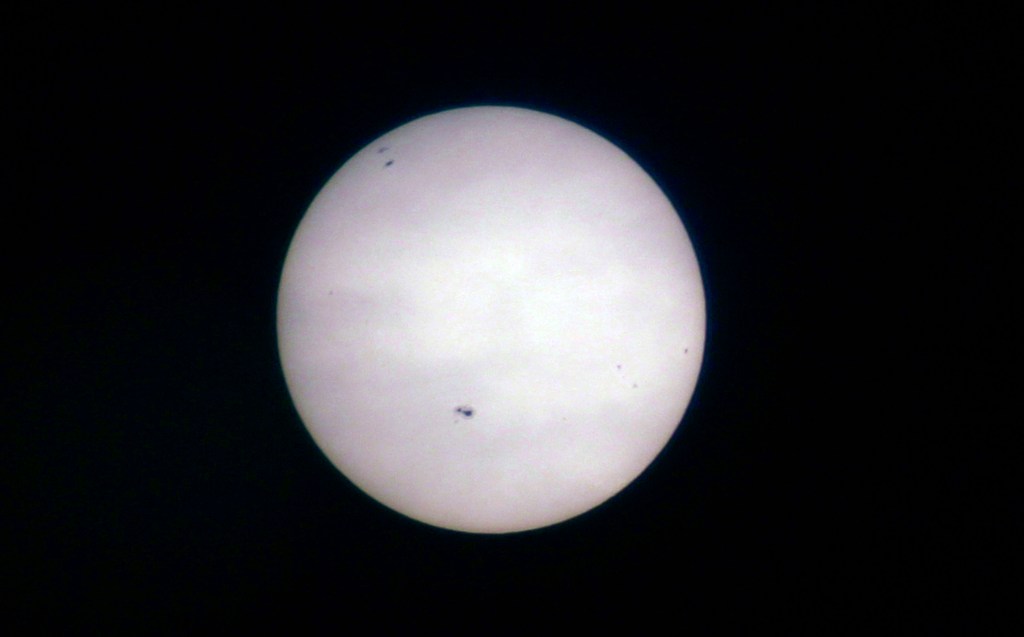
The sun looks like there’s bands and mottling around it; that is just that haze getting in the way again. If I had another photo taken when the sky was a little clearer, that would be apparent.
…I took another photo when the sky was a little clearer.

This was taken two days later. It was still hazy enough that I could take this photo without a solar filter, but the sun was higher in the sky. They’re moving: The sun is rotating.

The sunspots were shrinking, though. Here is the Umbra and Prenumbra for the August 14th photo:

The frustrating thing about the Prenumbra and Umbra with these stupid sunspots is that it reminds me of the eclipse again. Those words have two different meanings in Astronomy; for the sun they are the darkest centre and not-quite-as-dark bordering parts of the sunspot; for a lunar eclipse, the penumbra is the outer layer of the earth’s shadow covering up the moon, while the Umbra is the completely dark inner shadow. In March, we had a lunar eclipse, obviously, but this was a partial penumbral eclipse.

And of course I say ‘obviously’ because eclipses are paired, and I’m sure you knew that[crap- what’s the sarcasm emoji? How do I do any Emoji? How do I do sarcasm? This blog is a failure. Delete this note later]. Usually there will be a solar eclipse two weeks before or after a lunar eclipse(or in some cases, a string of three eclipses: solar-lunar-solar or lunar-solar-lunar). The earth, moon, and sun are on the same plane, so the the full moon will go dark as the earth blocks the sun’s light, and the earth while go dark when the new moon does it. However, the solar eclipse, if it is total, is only total from a narrow band across the earth’s surface; the lunar eclipse can be seen from anywhere on earth that has a view of the moon at the time. So, lunar eclipses seem to be more common, as it is visible over a larger section of the earth. Solar, you have to be in the right place, at the right time, and not get a bunch of idiot clouds ruining your fun.
And to reiterate, I am not just upset at the sun because it was cloudy on April 8th. I’m not vindictive. Not in that way. And I can prove it.
I didn’t say it was cloudy ‘all day’, just ‘almost all day’. It cleared up for about five minutes during the eclipse…And those were the coolest five minutes of a total eclipse, though; namely, the ‘total’.

a break of the clouds passed under the sun/moon just as the last of the sun was obscured. just as the sun started to reappear, the clouds came back. The view wasn’t as good as last time; only an A+++ instead of an A+++++. The corona(the white halo in an eclipse) wasn’t as visible as 2017. I had planned for a series of photos in different spectra- I actually wrote down which cameras to use with which filters, and when to change them. And I realized with the weather, I didn’t have time. The upper layer of clouds still partially obscured the eclipse, blocking the corona. That’s why it seems to be pointed downwards; where there were gaps, you could see more of it, and the gap in the clouds at the moment this photos was taken was beneath the eclipse. As the clouds were moving and the visible part of the corona was changing rapidly, I wouldn’t be able to compare the photos between spectra. Besides. It only was going to last for three minutes; I wanted some time to enjoy it(as originally planned for seconds 98-113 before attempting an UV shot).
So I missed the Corona, but there was a plus; this time, the solar prominences were clearer. Those are the red spots visible on the edge of the eclipse; a disruption in the magnetic field allow jets of plasma to arc away from the sun, and then force them to return to it. Kind of like a whale jumping out of the ocean, if that whale could burn away all life nearby if it escaped. So why didn’t I see them in 2017?
Looking at the 2017 photo in detail, Maybe I could have?
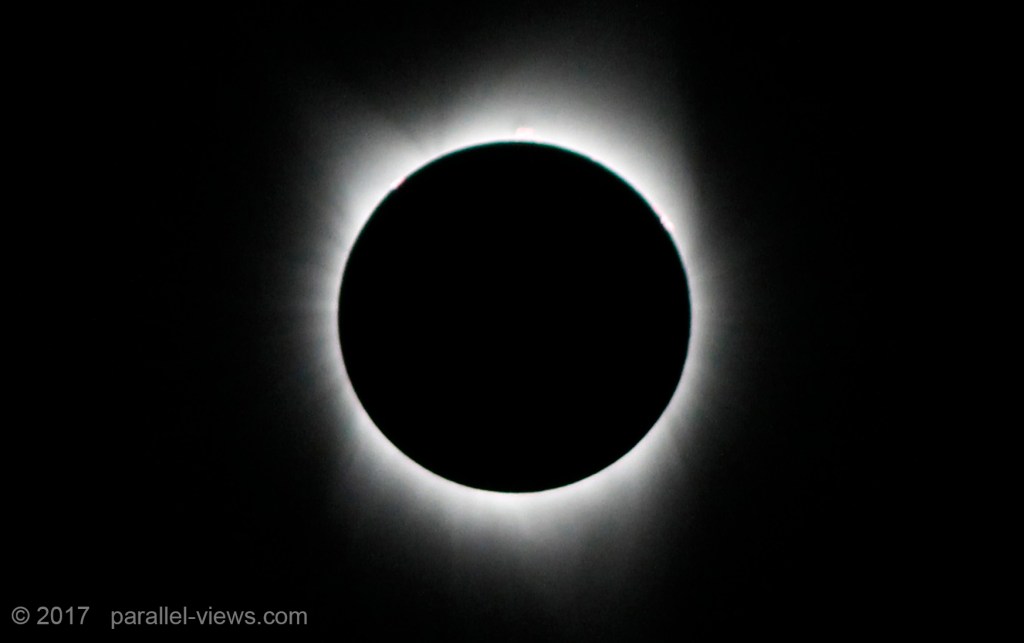
I don’t remember seeing it when I was there, but if I knock the brightness in the photo way down…
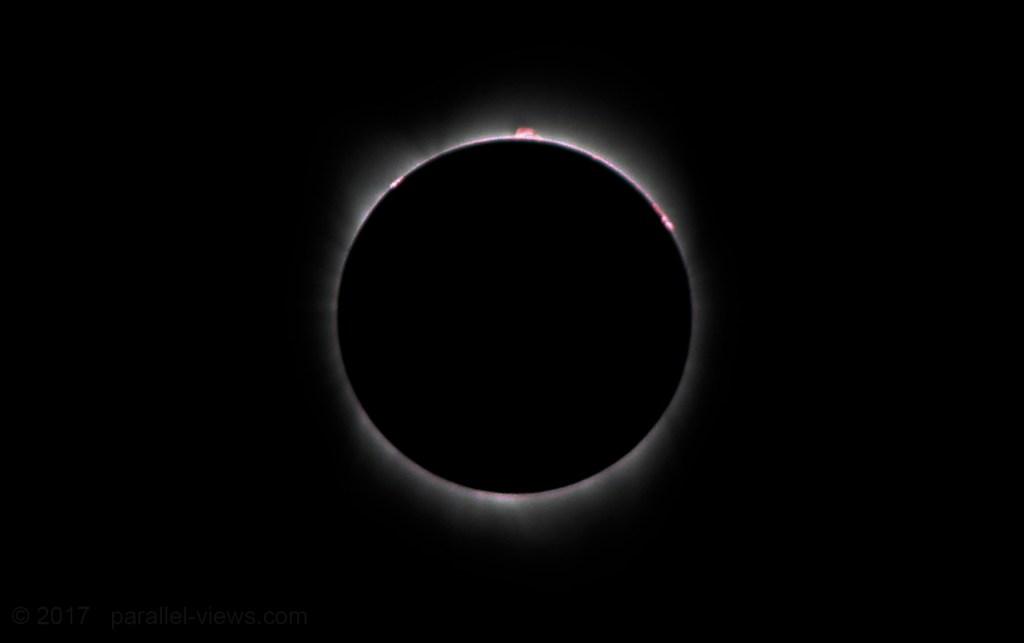
It’s there. There’s clearlay a large one at the top of the eclipse, and one on each side. It’s there, and looks similar to the 2024 prominences. But again, I don’t remember seeing it then, and I definitely saw it this time. I think because maybe the eclispe was dimmer this time. I think maybe the corona was too bright. It might have been dimmer this time because of the cloud… but there may be another reason too.
The moon and the sun appear to be the same size in the sky, but it varies. The moon gets closer, and appears bigger, or further, and appears smaller. The eclipse last fall in the USA the was an annular eclipse. In an annular eclipse The moon was further from the earth, and appeared smaller in the sky. As a result, , the moon can’t cover the sun completely. I’ve never seen one, but they look like this:

https://en.wikipedia.org/wiki/Solar_eclipse#/media/File:2023_Annual_Eclipse.jpg
For a total eclipse, the moon appears to be larger than the sun. I’m going to keep using ‘appears’ just in case anyone thinks I’m actually saying the moon is as large as the sun.
In another case of idiot astronomers reusing terms, the ratio of apparent moon size to sun size is called ‘magnitude‘. If the moon appears smaller than the sun, the magnitude is below 1.0; if larger, it is greater than 1.0. If it’s 1.0 or just a little above, It’s a hybrid eclipse… where depending on where you watch it might be annular, or it might be total.
For both of my eclipses, the ratio was well over 1, so the moon appeared larger than the sun and it blocked it completely. in 2017, it was magnitude 1.031, so the moon appeared to be just over 3% larger. However, the 2024 eclipse had the moon appear to be even larger, at 1.057. In other words it was just under 6% larger than the sun, so it blocked more of the inner corona. As it gets brighter the closer to the actual sun, maybe this dimmed it enough that the prominences stood out.
When I show these photos to people, I tend to dumb them down. I just call the prominences ‘Solar flares’. They aren’t, though. Whereas prominence are connected to the sun, a solar flare breaks free of the sun completely. They’re not very visible in the visible spectrum, instead being prominent in the shorter wavelengths(UV, X-rays, Gamma rays). I don’t think my camera could go far enough into UV to see them. So, they can’t be seen with the naked eye; you need to have specialized equipment to view-

…okay, they can be seen with the naked eye. Specifically they can be seen when they hit the earth. They charge the particles in the upper atmosphere; those particles radiate light. I should write about them sometime… or just write instead of putting this blog in a coma again. Auroras look pretty, and they’re another reason we have to destroy the sun. These flares can damage satellites. And there nothing on Coronal Mass Ejections.

These go hand-in-hand with solar flares; while the flares are high-energy radiation, CMEs are highly charged particles. If flares can damage satellites, these too, and they could also destroy the internet and the power grid. In fact, they already did 165 years ago; the Carrington Event damaged telegraph lines; overcharging them and sparking fires. Some lines, less damaged, were able to transmit without power; the charge from the geomagnetic storm was enough to power the systems.
And that’s why we have to destroy the sun… to save Youtube, Tiktok, and all the poor social medias. Can you live in a world without the constant flood of entertainment and of misinformation? Would you want to?
I’m glad I got this message out before the sun stopped me. Okay, as promised: here’s why I was gone so long. I’m only going to say this once, so remember this. In short, it was because I had

 Parallel Views
